Burr vs Blade Coffee Grinders: Which Is Better for Brewing?
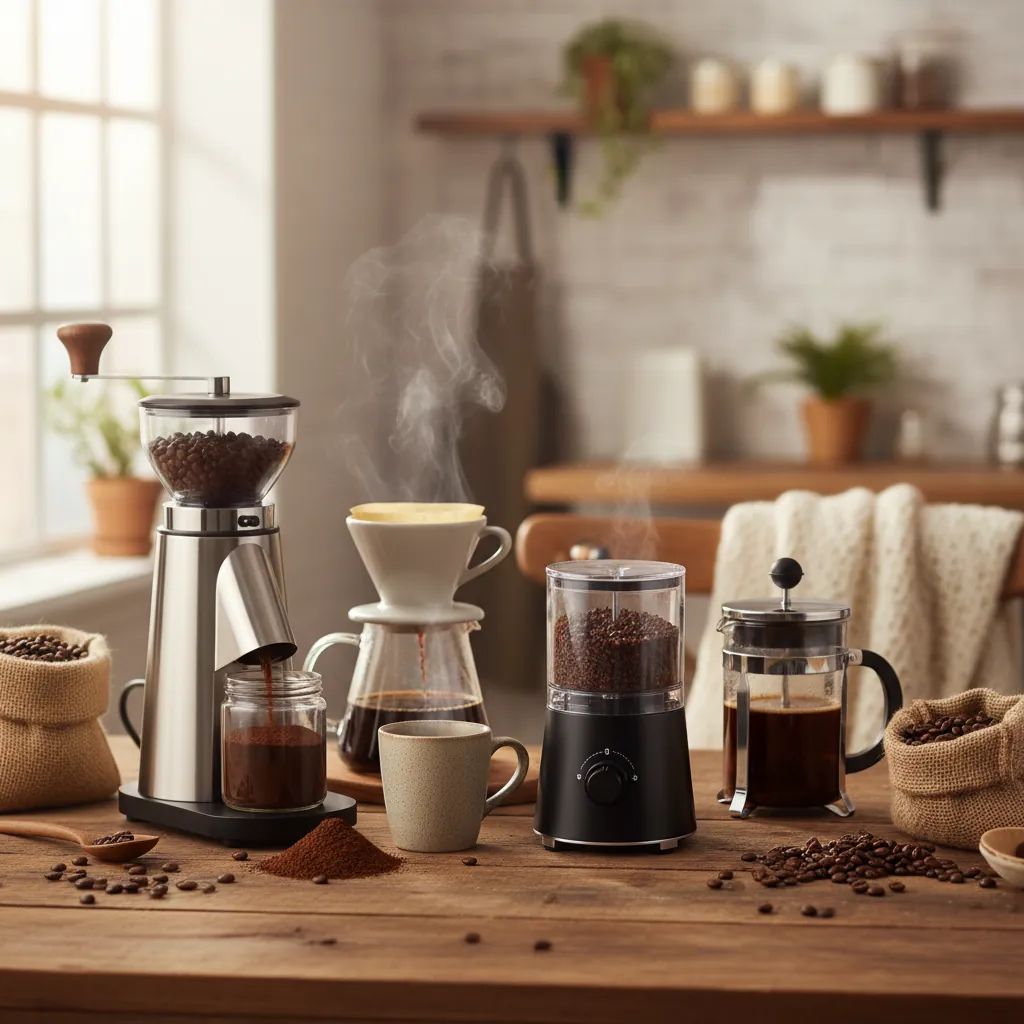
Burr vs Blade Coffee Grinders: Which Is Better for Brewing?
Contents
A burr grinder consistently outperforms a blade grinder for coffee quality. It crushes beans between two abrasive surfaces to produce uniform particles, enabling even extraction and balanced flavor. Blade grinders chop beans randomly, creating uneven grounds that lead to over- and under-extraction in the same cup. While burr grinders cost more ($60-$300 vs $20-$50), they’re the clear choice for espresso, pour-over, French press, and other brew methods.
What You’ll Need
- Burr grinder (hand or electric)
- Fresh whole coffee beans (30g per 500ml water)
- Filtered water (heated to 90-96°C / 195-205°F)
- Brewing device (e.g., French press, V60, espresso machine)
- Scale (for precise coffee-to-water ratios)
Step-by-Step
- Weigh beans: Measure 15-30g (or desired amount) based on your brew size.
- Set grind size: Adjust burr grinder per brew method (see table below).
- Grind beans: Run grinder until all beans are processed (15-60 sec depending on type).
- Brew immediately: Use grounds within 5 minutes to maximize freshness.
Burr vs Blade: Key Differences
| Feature | Burr Grinder | Blade Grinder |
|---|---|---|
| Grind consistency | Uniform particles (critical for even extraction) | Uneven mix of fines/boulders |
| Adjustability | Precise settings for all brew methods | No settings; grind time determines size |
| Price range | $60-$300 (hand); $100-$600 (electric) | $20-$50 |
| Best for | Espresso, pour-over, French press | Spices, emergency coffee grinding |
| Heat generation | Minimal (prevents flavor degradation) | High (can scorch beans) |
Tips
- Clean burrs monthly to prevent oil buildup affecting flavor.
- Hand grinders (e.g., Timemore C2) offer burr quality at lower cost but require effort.
- Pre-weigh beans to avoid static cling spilling grounds.
Common Mistakes
- Using stale beans: Grind quality can’t fix beans older than 3-4 weeks post-roast.
- Incorrect grind size: Too fine = bitter; too coarse = weak (adjust incrementally).
- Blade “pulsing”: Doesn’t improve consistency; creates more fines.
Variations
- Conical burrs: Better for espresso (Baratza Encore ESP, $199).
- Flat burrs: Ideal for pour-over (Fellow Ode Gen 2, $299).
- Travel grinders: Manual options like 1Zpresso Q2 fit in a cup.
FAQ
Can I use a blade grinder for espresso?
No. Espresso requires extremely uniform fine grinds; blade grinders cannot achieve this.
Is a $100 burr grinder worth it over a blade grinder?
Yes. Tests show even budget burr grinders (OXO Brew, $99) significantly improve flavor clarity.
How often should I replace burrs?
Every 500-1,000 lbs of coffee (~5 years for daily use). Worn burrs produce more fines.
Do blade grinders work for cold brew?
Poorly. While cold brew is forgiving, inconsistent grind still leads to muddy flavors.
Can I grind spices in a burr grinder?
Yes, but clean thoroughly afterward to avoid flavor transfer.
Related guides
- How to Descale an Espresso Machine: Step-by-Step Guide
- How to Choose and Use a Gooseneck Kettle for Perfect Pour-Over Coffee
- How Do People Typically Use the Barista Warrior Kettle in New Zealand Homes?
- How to Clean a Coffee Grinder for Optimal Flavor and Performance
- How to Clean a Drip Coffee Maker for Better-Tasting Coffee